Barrier Renewal & Brightening cream

Peptide serums are the quiet overachievers of skincare, and two names come up again and again: Matrixyl 3000 and Matrixyl synthe’6. Which one should you look for? The honest answer might surprise you.
If you are comparing Matrixyl synthe 6 vs 3000, start here: Matrixyl 3000 and Matrixyl synthe’6 are two different signal-peptide ingredients from the same supplier, Sederma, part of Croda. Matrixyl 3000 pairs palmitoyl tripeptide-1 with palmitoyl tetrapeptide-7 and is the more widely used. Synthe’6 is a single peptide, palmitoyl tripeptide-38, which the supplier tested on forehead and crow’s feet lines. Neither has been shown to outperform the other: we found no published head-to-head study, and most of the data on both come from the supplier. So rather than picking a winner, ask what each one adds. That is why our peptide serum uses both.
Key takeaways
In this guide
Peptides are short chains of amino acids. Cosmetic peptides are usually grouped into four families: signal, carrier, neurotransmitter-inhibiting and enzyme-inhibiting peptides (Schagen, 2017).
Signal peptides are modelled on fragments of the skin’s own proteins, many from the extracellular matrix, the network that gives skin its structure. In lab studies, they prompt skin cells to make more matrix proteins such as collagen and elastin (Ferreira et al., 2020). On skin, they are studied for their effect on the look of fine lines, firmness and smoothness.
The “palmitoyl” in each name is an attached fatty acid, used to help water-loving peptides move into the skin’s upper layers (Ferreira et al., 2020).

Matrixyl 3000 combines two peptides (Croda Beauty):
Both are widely used: in a study of 280 anti-ageing products sold in Portugal, they were the two most common peptides (Ferreira et al., 2020).
The research is thinner than that popularity suggests. Palmitoyl tripeptide-1 was tested in small, four-week studies of 15 and 23 women (Schagen, 2017). For the combination itself, the review’s anti-wrinkle evidence comes from a patent filed by Sederma (WO2012164488).
According to the supplier’s own tests, 39 men applied a cream with 4% Matrixyl 3000 to half the face, and a placebo to the other half, for 56 days. The area taken up by deep wrinkles fell by 29.4% from baseline on the treated side, against a 5.1% increase on the placebo side (Sederma technical brochure, 2007).
A 2020 review found that most clinical studies on cosmetic peptides are run by ingredient suppliers, usually aren’t published in peer-reviewed journals, and often don’t disclose their methods (Ferreira et al., 2020). When you read a claim, check who ran the test and against what.
Matrixyl synthe’6, often searched as Matrixyl synthe 6, is one peptide, palmitoyl tripeptide-38 (Pal-KMO2K). It is derived from KMK, a three-amino-acid sequence found naturally in collagen VI and laminins (Ferreira et al., 2020).
The supplier’s central claim is that it stimulates “6 major constituents of the skin matrix and the dermal–epidermal junction”, the layer where the outer skin meets the dermis (Croda Beauty). In its lab data, those six are collagens I, III and IV, hyaluronic acid, fibronectin and laminin-5 (Sederma technical brochure, 2010).
According to the supplier’s own tests, 25 women aged 42 to 70 used a cream with 2% Matrixyl synthe’6 twice daily for two months. Crow’s feet wrinkle volume fell by 21.1% compared with placebo, and maximum forehead wrinkle depth fell by 16.3% from baseline (Sederma technical brochure, 2010).
Independent evidence is scarce: the 2020 review cites only the supplier’s own document for this peptide (Ferreira et al., 2020). The two peer-reviewed human studies we found tested multi-ingredient products: a 28-day study of 32 women with sensitive skin (Schagen, 2017), and a 12-week open-label study of 37 women, measured only against their starting point (Herndon et al., 2015). So the peptide’s own effect can’t be separated out.
Rows marked “supplier” are according to the supplier’s own tests and documents for Matrixyl 3000 and synthe’6.
| Matrixyl 3000 | Matrixyl synthe’6 | |
|---|---|---|
| INCI name | Palmitoyl Tripeptide-1, Palmitoyl Tetrapeptide-7 | Palmitoyl Tripeptide-38 |
| Modelled on | A type I collagen fragment and an immunoglobulin G fragment | A sequence found in collagen VI and laminins |
| Main claim (supplier) | A “matrikines anti-wrinkle complex” | Stimulates “6 major constituents” of the skin matrix |
| Headline study (supplier) | 39 men, 56 days, half-face vs placebo | 25 women, two months, vs placebo |
| Peer-reviewed human evidence | A few small, short studies, mostly of palmitoyl tripeptide-1 | Only studies of multi-ingredient products |
Different panels, doses and comparisons mean the two supplier studies can’t be ranked against each other.
If neither is proven better, why use two? Because they are different tools: two widely used signal peptides in Matrixyl 3000, and a third, from a different sequence, in synthe’6. Together, they let one formula draw on two separate lines of peptide research.
To be clear: we found no study showing the combination works better than either alone. Using both is a considered formulation choice, not a proven synergy.
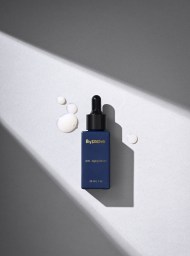
Product spotlight · Peptide Repair & Firming
Advanced Peptide Anti-Aging Serum
The dual-peptide complex: Palmitoyl Tripeptide-1 and Palmitoyl Tetrapeptide-7 (the peptides in Matrixyl 3000) plus Palmitoyl Tripeptide-38 (the peptide in Matrixyl synthe’6), alongside bearberry, gotu kola, Kakadu plum and licorice extracts and a touch of lactic acid. We don’t publish peptide percentages. Matrixyl is a trademark of Sederma; Bysachè is not affiliated with Sederma.
Apply 1–2 drops of our serum to cleansed skin, morning or evening; it is recommended for night-time use.
In the morning, a simple order is cleanser, vitamin C, peptide serum, moisturiser, then sunscreen. Our guide to layering vitamin C and peptides walks through each step, and our complete guide to vitamin C serum covers choosing one.
If you use a retinoid at night, add one new product at a time so you can see how your skin responds, and apply thinner textures first. If your retinoid is prescribed, follow your prescriber’s advice. Our layering guide sets out the order.
No serum replaces sunscreen. In an Australian trial of 903 adults over 4.5 years, the group assigned to daily sunscreen showed no detectable increase in skin ageing (Hughes et al., 2013). Make it the last step every morning.
A peptide routine, morning and night

